Mosaic of Colors

Artist Statement

Through the use of oil paint and large canvases, I create spaces where people are represented authentically. I believe life is about building meaningful relationships with those around me.

My portrait series gives me an opportunity to explore relationships and stories—through color, form, and composition, as well as through the process of painting people who share the commonality of having touched my life, but who differ in race, class, gender, and related life experiences.In addition, through my self-portraits, I am able to capture my own growth and maturity. The truth that I find in each individual’s life story – as I explore it through paint, and over time – inspires me. Some of the backgrounds of the portraits have stenciling that is illustrative of a theme throughout each story.

The thickness of paint, brush size, and intensity of color facilitate the solidarity that I feel with the subjects of my paintings. Oil paint is rich, vibrant, and fluid. Color and skin tones are often associated specifically as shades of brown, but I see so much more. I see human faces as a mosaic of colors that represent the layers of our existence.

It all began in one of my early art classes at Agnes Scott College (Digital Imaging) in 2008. We were given the assignment to create a short video pertaining to a topic of choice. I chose to address the notion of “inclusiveness” as it relates to Agnes Scott:

http://portfolio.agnesscott.edu/jcasteel/

My Art In Depth

The subjects of my paintings (MileHigh, Mrs. Betty, and Alex) are connected to one another because they are each connected to me.


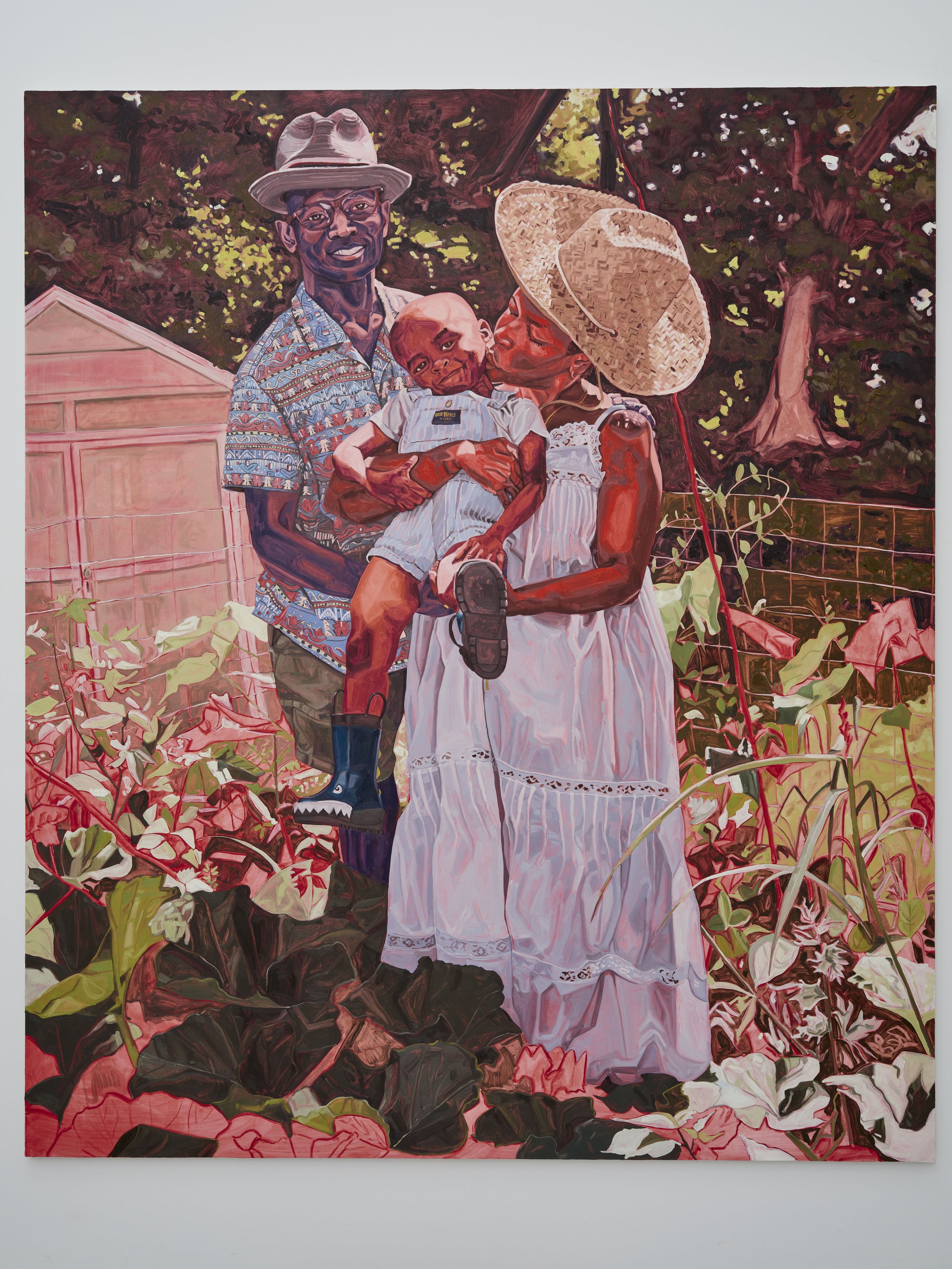
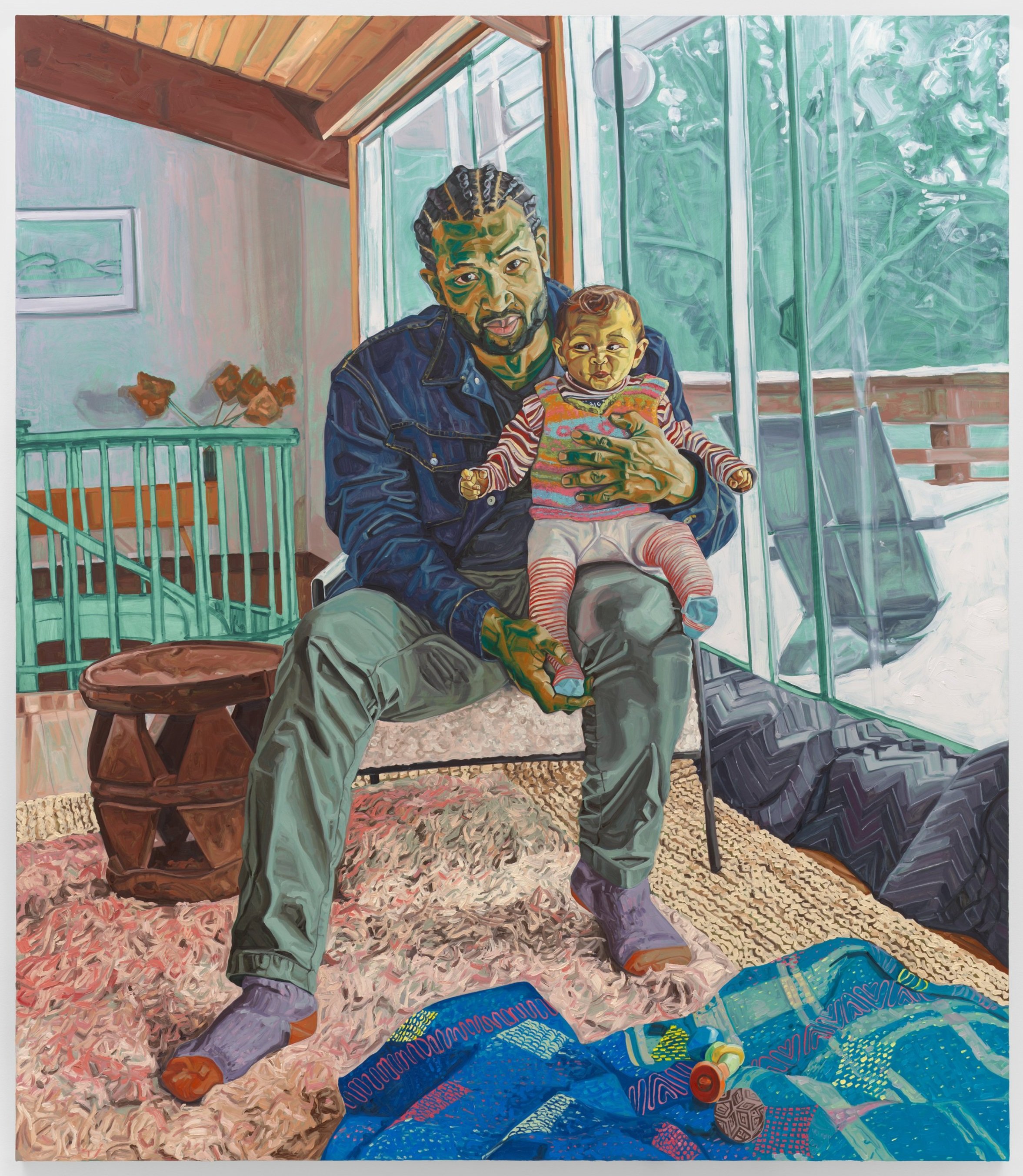
The first painting of the series holds many complexities – primarily because it is a portrait of my twin brother. Painting this portrait has functioned as a sort of salute to my brother and his young son. In doing this portrait, I have been able to reconnect to him in ways that I might not have been able to before. This has showed me the power of art, and its ability to transcend personal differences. When putting this portrait together, I started with the subjects – Miles and his son, Johsyah. I had told my brother beforehand that I would be taking pictures of him – allowing him to have choice in what he wore for that day.  When the camera came between us, it seemed he relaxed into a confident and sincere smile while holding his son. I took many pictures that day and ultimately chose to paint one in which Miles and Johsyah look right at the voyeur.  In their gaze, we are forced to wonder what the story is.

Beyond the direct eye contact, there is a reflection of the father in the son. The father is wearing a crown of sorts, a crown that is a depiction of Miles’ status in society. The DuRag Crown is an embellishment that Miles wears proudly as a mark of his blackness. This DuRag is also suggested in the young boy’s flyaway curls that escape his cornrow braids. There is an element of youth in the un-kept nature of his hair, but also depicts who this child may become. Beyond the braids, Johsyah wears an earring that mirrors a culture into which his father so desperately wants him to be accepted.

Upon finishing the father/son pair, I moved into a dialog about my relationship with these individuals. I wanted the background to reflect who my brother is to me in a truly genuine way.  “MileHigh” is a tattoo that is large across Miles’ back and speaks to many aspects of his lifestyle. His tattoos climb his back, arms, and fingers and, once again, adorn him. These words and symbols give him position and rank amongst peers. As Miles says, “MileHigh city [Denver, Colorado] is where I was born and I will rep it until I die.”  I created the stencil by hand after drawing a replica of the tattoo as it exists on his back.  The words are replicated again and again on the background as another form of adornment, place and position. As “MileHigh” begins to exist in mass quantities on the background, the phrase also has moments in which it crosses the figure ever so slightly. These moments are moments in which the background and foreground are confused. This is much like the identity that Miles continues to try to embody.

The next painting in the series is of a woman who has touched my life over the past four years in a real way.  She, much like many people in this world, has fallen behind the scenes. Her story has been lost in the history of Agnes Scott College. Mrs. Betty is a woman who has touched the lives of students such as myself in equal, if not greater, ways than many other faculty or staff on campus because of her gentle nurturing and compassion. The scale of the canvas was necessary in displaying the magnitude of her character – particularly in my life. She, like my brother, had an opportunity to choose how she wanted to represent herself. She came to my studio wearing all white, looking literally like an angel.  This angel, sitting with her fingers interlocked and hands in her lap, chose to show herself in this way. The colors in this piece are chosen to represent this heaven-like presence. The background mimics the beautiful blue that is our sky. Her blouse is reminiscent of clouds.  Mrs. Betty has literally become the heavens in this portrait.

The stenciled words that accompany the figure read, “was beautiful.” In conversations with Mrs. Betty she is often referring to her beauty in the past tense. But, I think she IS beautiful. Beauty is characterized by traditional standards – thus the Times New Roman font. However, I believe Mrs. Betty is one of the most beautiful women I know and so, with my own hand, I went through and changed all the “was’” to “is” or “as” beautiful.  Automatically, my hand marks interrupt the standard, creating vulnerability and speaking to a truth.  The text on the background of this portrait, similar to the portrait of Miles and his son Johsyah, is patterned around the figure – with moments of overlap that confuse the background and foreground.

The final portrait in the series is of my best friend whom I met my first-year at Agnes Scott. As my randomly selected roommate, we initially seemed to be an odd match. As we both judged one another, we closed our minds to the possibility of getting to know one another. We appeared to be from different worlds: we talked differently, dressed differently, and were from different parts of the country. Physically – she is short, I am tall, she had darker skin, mine is more fair, I was “white washed” and she was “hood”. Quickly this relationship changed when we found our personality differences could be beneficial for one another. She taught me to not be afraid of the system, and I taught her to be more sensitive.

Alex, my best friend, had a choice in how she wanted to be represented, just like the subjects of my two other portraits.  Now, a business student at Florida A&M University she posed for the picture in a black suit holding a book. Because her skin tone is darker than either of my previous subjects, I was able to use richer colors. Even the black suit has shades to differentiate folds and shadows. The background colors complement the figure and help to draw attention to the form.  Green and purple – complementary but different colors – highlight the necessary “code-switching” Alex has to take part in everyday to be successful in the white patriarchal business world. She is very much aware of the system and is determined to beat it. This has become the inspiration for the stenciling in the background of the portrait, “beating the system”. Alex as a young black woman has many obstacles to overcome, but I have no doubt that she will be able to achieve anything she sets her mind on. The green words climb the page; drawing us upward and into the unknown heights she could potentially reach.  The purple words are read traditionally and draw our attention to the many different directions she might begin to beat the system.

Overall, this collection of work is just the beginning. Through showing specific and real figures in my life – I have allowed myself to be vulnerable with my own race, identity, and gender. In the course of my own exploration of self, I am offering the viewer an opportunity to question his or her own identities. Many artists such as Alice Neel, Kehinde Wiley, and Egon Schiele have inspired my work. All three of these artists focus on genuine expressions of self. However, each artist has different techniques, and thus a different voice. Neel has particularly inspired my brave use of color. Wiley has opened my eyes to the possibilities of a young black artist and the use of backgrounds. He is working on sharing the story of race in a similar dynamic as myself. Schiele’s brutally authentic portraits have pushed me to trust my own expression and vision of people. My hope is that through this process I can affect others with my voice. I want people to begin to see and give voice to the people in their own lives.